Color appearance phenomena
Abney effect
(Purity on hue effect)
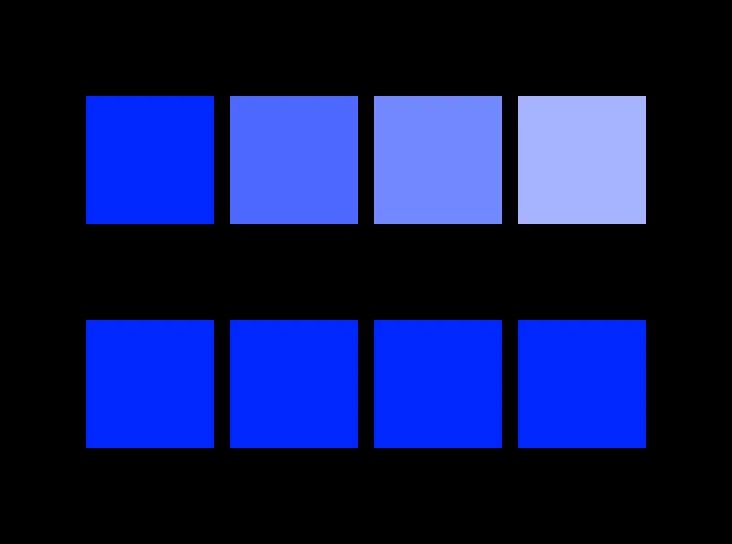
How it affects UI design
When creating color scales, or tints of a color, artificially shifting the hue will help combat the Abney effect.
The Abney effect is created from additive color mixing. A related phenomenon is the Bezold–Brücke shift, which can help to inform the creation of tints with natural hue appearance.
Related topics
Sources:
- Thomas Norton, David Corliss, James Bailey (2020). The Psychophysical Measurement of Visual Function. 1st edition. Butterworth-Heinemann. Pages 261
- Mark D. Fairchild (2013). Color Appearance Models. 3rd edition. John Wiley & Sons, Ltd. Pages 241, 263
- Abney effect. Wikipedia. https://en.wikipedia.org/wiki/Abney_effect
- Abney effect: what it is and how it influences our perception of color. PsychologySays.net. https://psychologysays.net/neurosciences/abney-effect-what-it-is-and-how-it-influences-our-perception-of-color/