Contrast & visual acuity
Stevens' power law
(Successor to the Weber-Fechner law)
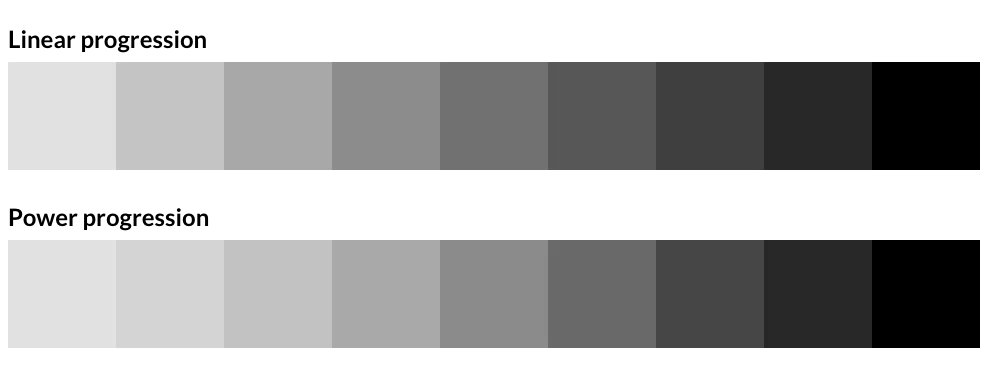
The perceived rate of change in stimulus differs from the actual rate of change. It progresses by a multiplying factor against the actual intensity (a power function).
How it affects UI design
When creating a color scale, Stevens' power law can inform your decision on how to make the progression of tints and shades appear perceptually balanced.
Some color appearance models are built with considerations to Stevens' power law.
Always ensure that there are colors in your color scale that meet or exceed WCAG 1.4.3 (contrast minimum), regardless of their appearance on a scale.
Sources:
- Thomas Norton, David Corliss, James Bailey (2020). The Psychophysical Measurement of Visual Function. 1st edition. Butterworth-Heinemann. Pages 29-30
- Mark D. Fairchild (2013). Color Appearance Models. 3rd edition. John Wiley & Sons, Ltd. Pages 42, 128
- Janos Schanda (2007). Colorimetry: understanding the CIE system. John Wiley & Sons, Inc. Pages 274