Contrast & visual acuity
Contrast sensitivity
A measurement of a person's ability to distinguish an object from its background.
Contrast sensitivity is affected by lighting intensity and spatial frequency. Sensitivity thresholds are unique to individuals based on a number of factors (such as cataracts or damage to the optic nerve).
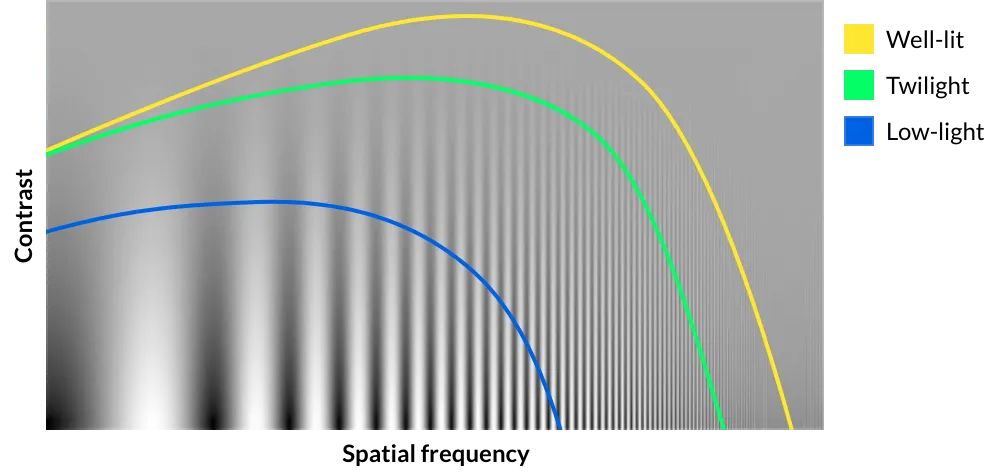
Example
Use the controls to change the spatial frequency (width) of the vertical bands, contrast, and brightness of the simulation.
For this test, people are shown sets of discs with progressively lower contrast (at fixed widths). They are asked to identify the lowest contrast disc in which they can still see the vertical bands.
Results are plotted against a chart (like the example above) to identify the individual's contrast sensitivity.
Note: This is a simulation of the contrast sensitivity test and is not intended to be used for actual contrast sensitivity testing or diagnosis.
How it affects UI design
Not all people have the same contrast sensitivity. WCAG 1.4.3 (contrast minimum) provides a general threshold for making text & components perceivable to most sighted users.
Typographic sizes and font weights affect the perception of contrast in text. Lighter font weights (or smaller text) should use higher contrast colors.
In some cases, users may benefit from higher contrast than recommended minimums, whereas other users may be negatively impacted by high contrast interfaces. Consider personalization settings to give users the ability to adjust contrast to meet their needs.
Supporting iOS increase contrast mode and Windows high contrast mode will help users with low contrast sensitivity.
Additional factors need to be considered from related sources below.
Sources:
- Mark D. Fairchild (2013). Color Appearance Models. 3rd edition. John Wiley & Sons, Ltd. Pages 28-29
- Thomas Norton, David Corliss, James Bailey (2020). The Psychophysical Measurement of Visual Function. 1st edition. Butterworth-Heinemann. Pages 149-151
- Vicki Bruce, Patrick R. Green, Mark A. Georgeson (2003). Visual Perception. 4th edition. Psychology Press. Pages 34
- John F. Salmon MD, FRCS, FRCOphth. Contrast sensitivity. https://www.sciencedirect.com/topics/medicine-and-dentistry/contrast-sensitivity#:~:text=Contrast%20sensitivity%20is%20a%20measure,background%20than%20a%20black%20letter.
- Contrast sensitivity function. . https://www.ncbi.nlm.nih.gov/books/NBK219042/