Visual impairments
Anomalous trichromacy
A type of color vision deficiency where one of the cone pigments in the eye has a different wavelength sensitivity than normal. Approximately 6% of males and 0.4% of females are anomalous trichromats.
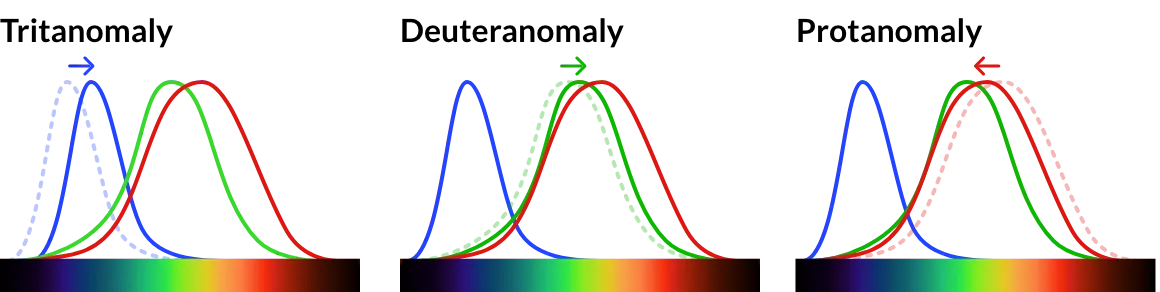
Deuteranomaly
This type of color vision is caused by malfunctioning medium wavelength (green) cones.
Deuteranomaly is the most common and affects 4.63% of men and 0.36% of women.



Protanomaly
This type of color vision is caused by malfunctioning long wavelength (red) cones.
Protanomaly is less common and affects 1.08% of men and 0.03% of women.


Tritanomaly
This type of color vision is caused by malfunctioning short wavelength (blue) cones.
Tritanomaly is very rare and affects 0.0002% of men.


How it affects UI design
Designing with color vision deficiencies in mind is important. Most issues can be resolved by compliance with WCAG 1.4.1 (use of color) and 1.4.3 (contrast minimum).
When color identification is important to all sighted users, use a color tool to evaluate color difference for each color deficiency type.
Most simulation tools imply a fixed experience for each vision type. Anomalous trichromats vary in the strength of their color deficiencies. Reliance on these tools (along with subjective decisions) can result in falsely identifying safe colors.
- Helpful tools:
- Coblis: https://www.color-blindness.com/coblis-color-blindness-simulator/
- CVD Simulation Web App: https://www.myndex.com/CVD/
- Colorblindly: https://chrome.google.com/webstore/detail/colorblindly/floniaahmccleoclneebhhmnjgdfijgg
- Leonardo color: https://leonardocolor.io
Sources:
- Thomas Norton, David Corliss, James Bailey (2020). The Psychophysical Measurement of Visual Function. 1st edition. Butterworth-Heinemann. Pages 268-269
- J.D. Mollon, J. Pokorny, K. Knoblauch (2003). Normal & Defective Colour Vision. Oxford University Press. Pages 202-201
- R.W.G. Hunt, M.R. Pointer (2011). Measuring Colour. John Wiley & Sons, Inc. Pages 438, 445
- Daniel Flück. Types of color blindness. Colblindor. https://www.color-blindness.com/types-of-color-blindness/
- Success Criterion 1.4.1 Use of Color. Web Content Accessibility Guidelines (WCAG) 2.1. https://www.w3.org/TR/WCAG21/#use-of-color
- Success Criterion 1.4.3 Contrast (Minimum). Web Content Accessibility Guidelines (WCAG) 2.1. https://www.w3.org/TR/WCAG21/#contrast-minimum