Color spaces
Color appearance model
(Uniform color space)
A dynamic color space that accounts for perceptual effects of color vision.
When implemented under fixed viewing conditions, a color appearance model becomes a uniform color space.
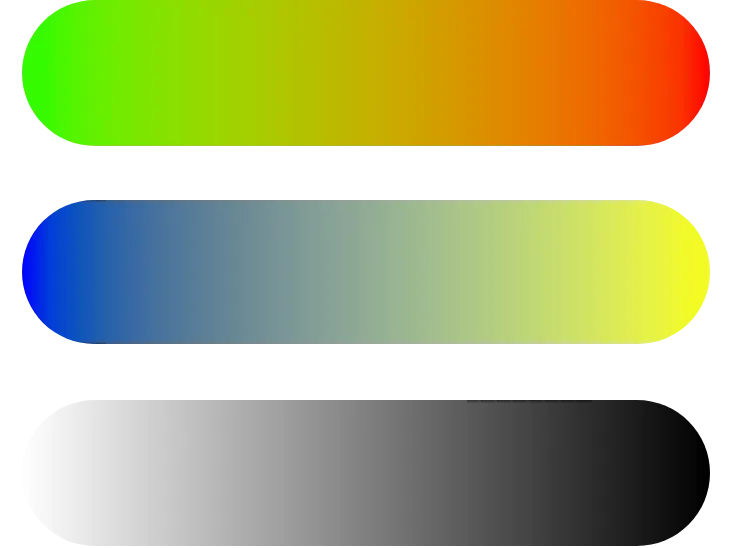
Because of their perceptual basis, they are also referred to as opponent color spaces.
How it affects UI design
Color appearance models are better color spaces for evaluating color and creating color scales.
Most uses of color in user interfaces are not affected by color appearance models. You do not need to rely on these color spaces to create aesthetically appealing and accessible colors.
Uniform color spaces are linear models of human vision. However, human perception is non-linear. Do not rely on these color spaces alone to create aesthetically balanced colors.
Browser support is still growing for LAB, OKLAB, LCH and OKLCH color spaces. Check CSS Module level 4 for more detail.
Sources:
- Mark D. Fairchild (2013). Color Appearance Models. 3rd edition. John Wiley & Sons, Ltd. Pages 199-200
- R.W.G. Hunt (2004). The Reproduction of Colour. John Wiley & Sons, Inc. Pages 116, 587-636
- Janos Schanda (2007). Colorimetry: understanding the CIE system. John Wiley & Sons, Inc. Pages 446
- R.W.G. Hunt, M.R. Pointer (2011). Measuring Colour. John Wiley & Sons, Inc. Pages 129, 293