Color vision
Color opponent process
(Color opponency)
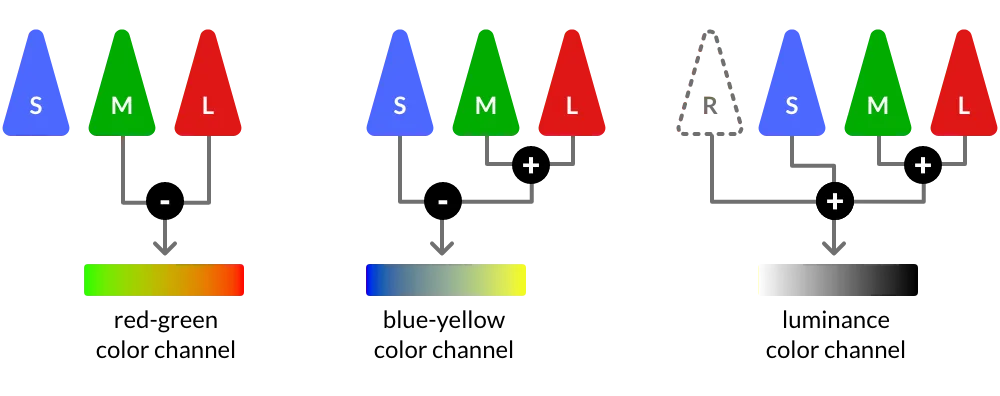
An aspect of color vision where sensory signals are linked between different cones. These links inhibit signals sent to the visual system, cancelling out the opponent color.
This secondary process creates the red-green, blue-yellow, and luminance channels of vision (used in color appearance models).
See how it works*
Use the slider to adjust the wavelength of light to see how short (SWS / blue) cones, medium (MWS / green), and long wavelength sensitive cones (LWS / red) react to create the opponent channels and inform the perception of color.
Photoreceptors
Opponent channels
Perceived color
* Note: This simulation is intended to assist in demonstrating the concept behind the color opponent process. It is not scientifically accurate and does not account for color compositions or the luminosity channel (cones + rods).
Related topics
Sources:
- Thomas Norton, David Corliss, James Bailey (2020). The Psychophysical Measurement of Visual Function. 1st edition. Butterworth-Heinemann. Pages 256-259
- Donald D. Hoffman (1998). Visual Intelligence. W. W. Norton & Company. Pages 133-134
- Opponent process. Wikipedia. https://en.wikipedia.org/wiki/Opponent_process